
If you run a business or a practice and your accounts are subject to tax audit, there’s a date mix-up going around, so here is where things actually stand.
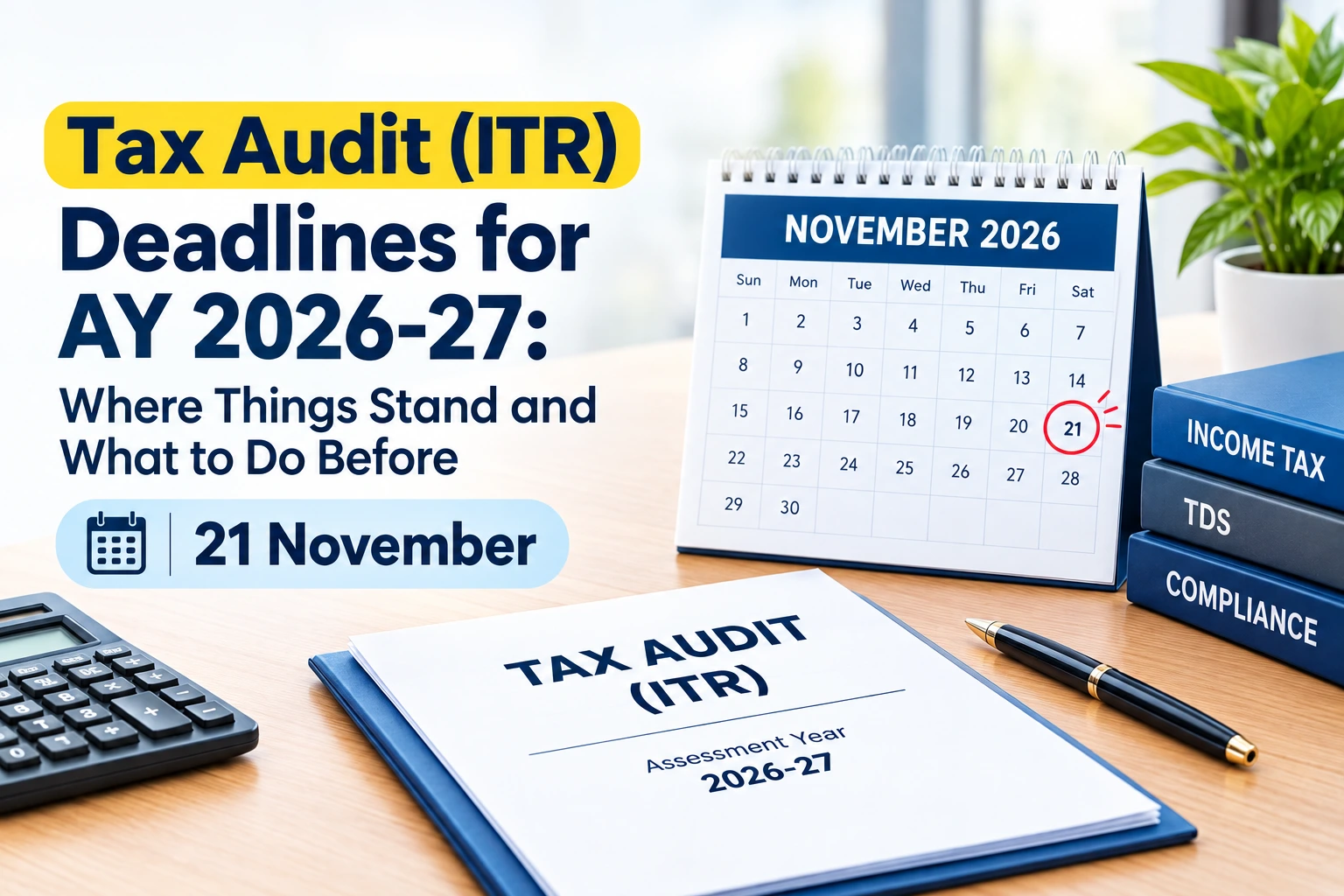
The tax audit report was due on 30 September. CBDT pushed it to 21 October 2026. The return of income for audit cases, originally due 31 October, is now due on 21 November 2026. The October date has gone, and the next one to plan around is 21 November.
| What | Original date | Current date |
| Tax audit report (Form 3CA/3CB with 3CD) | 30 Sep 2026 | 21 Oct 2026 |
| ITR for audit cases | 31 Oct 2026 | 21 Nov 2026 |
| ITR where transfer pricing (Sec 92E) applies | 30 Nov 2026 | 30 Nov 2026 (no change announced) |
Salaried individuals and non-audit business filers were not part of this extension. Their dates were 31 July and 31 August respectively.
Who needs a tax audit in the first place?
Under Section 44AB, you generally need one if:
- Your business turnover is above ₹1 crore. The limit is ₹10 crore if cash receipts and cash payments are each 5% or less of the total.
- Your professional gross receipts are above ₹50 lakh.
- You’ve opted for presumptive taxation but declared profit below the prescribed rate, and your income is above the basic exemption limit.
Work out which of these applies to you. Many people assume they’re out of the net and find otherwise in October.
Checklist for the next four weeks
- Check whether your audit report is actually filed. Your CA uploads it on the income tax portal. It then shows up in your login, and you have to accept it there. Sit with your CA and confirm that step is done, since the return can’t be filed properly without it.
- Reconcile your books with the government’s records. Match your books against Form 26AS and the Annual Information Statement (AIS). Mismatches in TDS credits and reported receipts are the usual cause of notices later.
- Match your sales to your GST returns. Turnover in your books, GSTR-1 and GSTR-3B should tell the same story. If they don’t, find out why before the return goes in.
- Sort out your cash and payment trail. Cash payments above the limits and payments to specified persons can lead to disallowances. Your auditor will ask about these, so have the explanations and papers ready.
- Confirm TDS and TCS compliance. Late deposits, short deductions and missed returns can lead to expense disallowance. Get this tidied while there’s still time.
- Check MSME payments. Payments to micro and small enterprises beyond the agreed period (or the statutory limit, if no agreement) can make that expense non-deductible until paid. Look at your vendor list.
- Settle your balance sheet. Loans, partner capital, outstanding creditors and fixed asset records need to be consistent with each other. Rough numbers lead to long audit queries.
- Calculate advance tax and interest. If tax is still payable, pay it before filing and keep the challan. Interest under Sections 234A, 234B and 234C will add up.
- Carry out proper verification. Return filers must e-verify within the prescribed time. An unverified return is treated as not filed.
What happens if you miss it
- Penalty for missing the audit itself: Section 271B can impose a penalty of 0.5% of turnover or gross receipts, capped at ₹1,50,000, unless you show reasonable cause.
- Late fee: Section 234F is ₹5,000 for a late return (₹1,000 if total income is ₹5 lakh or less).
- Interest: Section 234A charges 1% a month on unpaid tax from the due date.
- Loss carry-forward: A late return can cost you the right to carry forward most business losses.
A belated return is still possible until 31 December 2026, but you’ll pay for the delay.
A practical note
Extensions can change, and the details depend on your situation, such as transfer pricing or special categories. This post is general information, not advice for your particular case.