A client of mine once lost out on a six-figure contract for one reason: she wasn’t ISO certified. Everything else about her proposal checked out. The pricing was competitive, the references were solid, the timeline worked. But the procurement team had a box to tick, and she couldn’t tick it.
That’s the kind of moment that makes small business owners start Googling “is ISO certification worth it” at eleven at night. So let’s actually answer that, without the sales pitch.
What ISO Certification Actually Means
ISO — the International Organization for Standardization — writes standards for how businesses should run their processes, whether that’s quality control, data security, or environmental impact. Getting “certified” means an outside auditor has checked your business against one of those standards and signed off that you meet it. It’s not something ISO itself hands out; accredited certification bodies do the auditing.
A handful of standards come up again and again for small businesses:
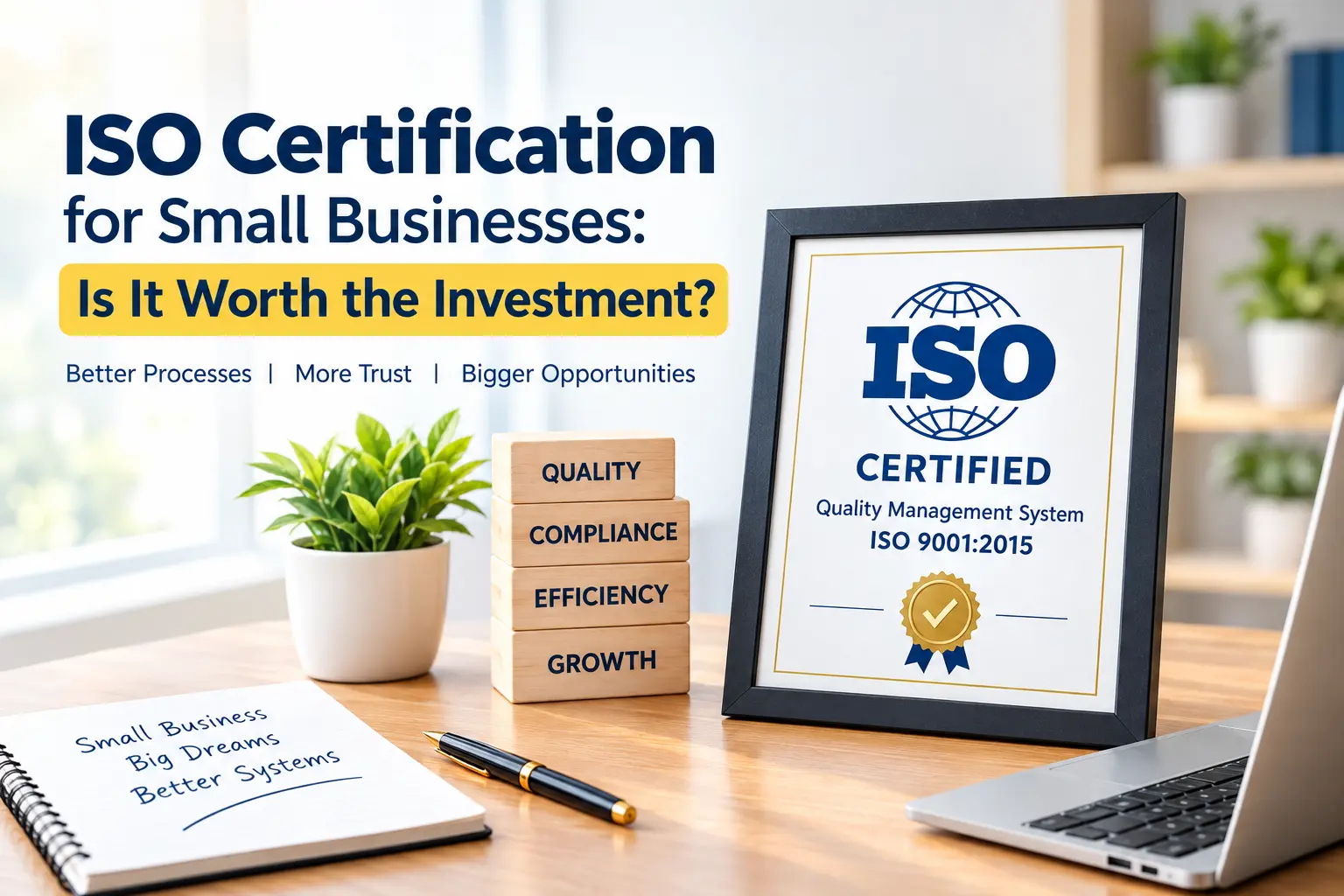
- ISO 9001 covers quality management. It’s by far the most common one, and honestly the one most small businesses mean when they just say “ISO certified.”
- ISO 27001 is for information security — increasingly requested by clients who hand over sensitive data, especially in tech and finance.
- ISO 14001 deals with environmental management, common in manufacturing and construction.
- ISO 45001 covers workplace health and safety.
- ISO 22000 is specific to food safety.
Each one comes with its own set of requirements, but the shape of the process is similar: build documented systems, train your team to follow them, run internal checks, then bring in an accredited auditor to confirm it’s real and not just paperwork.
Why Small Businesses Actually Go Through With It
Nobody pursues ISO certification for fun. It usually comes down to one of these:
A contract requires it. This is the big one. Government tenders, enterprise clients, and supply chains for larger companies often won’t even open a proposal from a vendor who isn’t certified.
Growth has outpaced the systems. A business that ran fine on tribal knowledge at five employees starts breaking down at twenty-five. Using ISO 9001 as a framework gives owners a structured way to fix that instead of guessing.
Trust needs to be demonstrable, not just claimed. Anyone can say “we take quality seriously.” Certification is a third party backing that up.
What You Actually Get Out of It
The obvious benefit is access — the doors that stay shut without a certificate suddenly open. But owners who’ve been through the process tend to mention a few other things that surprised them:
The documentation exercise itself exposes problems. You can’t write down “here’s how we handle a customer complaint” without noticing that, actually, three different employees handle it three different ways. That gap-finding is uncomfortable but useful.
It gives new hires something to train against instead of shadowing someone for two weeks and hoping it sticks.
Insurance and lenders sometimes take it as a signal of lower risk, which can occasionally show up in better terms — worth asking about if you’re already certified or considering it.
And there’s a quieter benefit: it’s genuinely hard for competitors to fake. Anyone can put “committed to quality” on a website. Not everyone has sat through an external audit and passed.
What It Costs, Realistically
This is where a lot of the vague blog posts online fall short, so here are real numbers. Based on current industry pricing for ISO 9001, small businesses (roughly under 50 employees) are generally looking at somewhere in the 30,000–75,000 range for first-year certification, and some businesses with more complexity or that lean heavily on consultants end up closer to 75,000–1,50,000 once everything is factored in.
That figure usually breaks down into:
- Consultant or toolkit fees, if you use outside help to build your management system
- The certification body’s audit fee itself, which covers the Stage 1 (documentation review) and Stage 2 (on-site or remote) audits.
- Internal staff time, which doesn’t show up on an invoice but is real — expect weeks, not days, spread across the people responsible for building and documenting the system.
- Training costs, if staff need to learn new procedures or software.
Certification also isn’t a one-and-done expense. It’s valid for three years, but certifying bodies run annual surveillance audits in between to make sure you’re still following what you said you’d follow. Budget for that ongoing cost, not just the first year.
One more thing worth naming honestly: the cultural friction. Employees who’ve been doing something their own way for a decade don’t always love being told to fill out a new form for it. That resistance is normal and usually fades once people see the system actually catch a problem before it becomes a customer complaint.
So, Is It Worth It?
It depends less on your industry and more on where the pressure is coming from. A few honest questions to sit with:
Is a specific contract or client actually asking for it right now?
If yes, this usually isn’t really a debate — you either get certified or you stop bidding on that kind of work. The math tends to work itself out fast when there’s revenue attached.
Are you losing time or money to inconsistent processes anyway?
If your team is already reinventing the wheel every time something goes slightly off-script, the ISO 9001 framework can pay for itself in operational cleanup alone, certification aside.
Can the business survive the distraction?
Building a management system pulls attention away from day-to-day operations for a few months. If you’re mid-crisis or barely keeping up as it is, this might not be the season for it.
Do you have the cash without white-knuckling payroll?
If not, there are cheaper ways to start.
If You’re Not Ready to Commit Yet
Full certification isn’t all-or-nothing. A few middle-ground options:
You can run your business by ISO 9001 principles without ever paying for the audit. Nobody’s stopping you from building the documentation and quality checks on your own timeline, then deciding later whether the certificate itself is worth paying for.
A gap analysis — usually a few hundred to a couple thousand dollars — tells you exactly how far your current processes are from meeting the standard, so you’re not budgeting blind.
Some industries have narrower, cheaper certifications that matter more to your specific buyers than a broad ISO standard would. It’s worth asking your target clients what they actually check for before assuming ISO is the answer.
The Short Version
If a contract you want requires it, get certified — the return usually shows up fast. If nothing’s forcing your hand, the decision comes down to whether your business is stable enough, and big enough, that better documented processes would actually move the needle. For a five-person shop running smoothly on instinct, it might be overkill. For a twenty-person company that’s starting to feel the cracks, it’s often exactly the right kind of pressure.