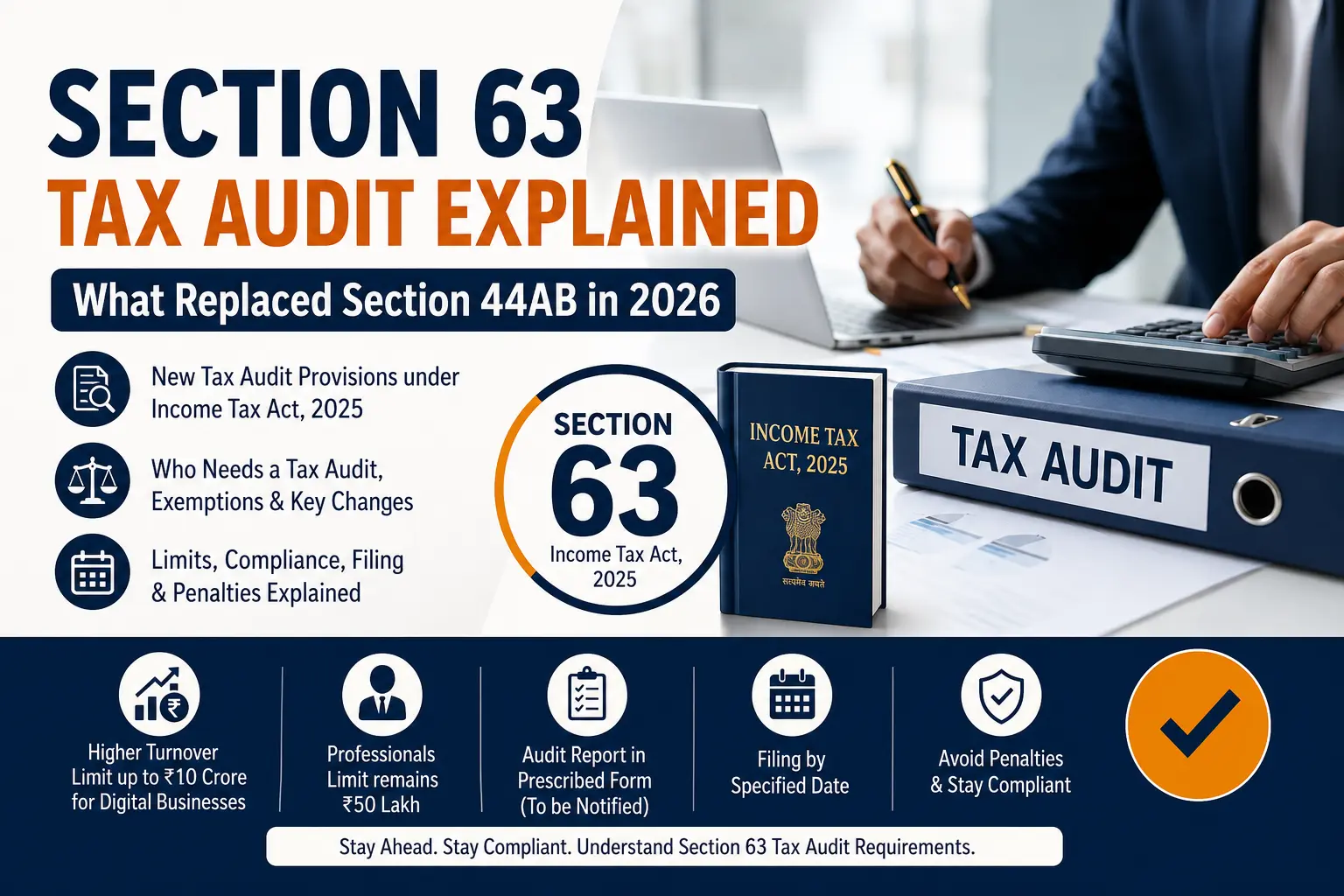
A client called me last week and asked, “My CA says I need a Section 63 audit now — but I thought the tax audit was under 44AB?” He’s not wrong to be confused. For over four decades, Section 44AB was the go-to reference for tax audits in India. From FY 2026-27 onward, that number is gone, and Section 63 of the Income Tax Act, 2025 has taken its place.
If you run a business or a profession, here’s what actually changed, and whether you now fall into the audit net.
What Is Section 63 of the Income Tax Act, 2025?
Section 63 is the new provision governing tax audit requirements in India. It replaces Section 44AB of the old 1961 Act and applies from Tax Year 2026-27 onward. If you’re filing for FY 2025-26 (AY 2026-27) right now, you’re still under the old 44AB rules — the switch only kicks in for the tax year that started April 1, 2026.
In simple terms: same purpose, new number, and a few real changes underneath.
Section 63 vs Section 44AB: What’s Actually Different
The core idea hasn’t changed — a Chartered Accountant still has to verify your books before you file your return. But Section 63 tax audit rules bring sharper thresholds, especially for digital-first businesses. If most of your transactions happen through UPI, cards, or bank transfers, the law now rewards that with a higher audit-free limit.
Who Needs a Tax Audit Under Section 63?
Here’s who falls under the Section 63 tax audit requirement:
- Businesses with turnover above ₹1 crore — the standard trigger, same as before.
- Businesses with turnover up to ₹10 crore — audit isn’t mandatory if cash receipts and cash payments each stay under 5% of the total. This is the biggest shift: businesses that operate almost entirely on digital payments get real breathing room.
- Professionals with gross receipts above ₹50 lakh — architects, doctors, consultants, and similar professionals are still covered at this threshold.
- Anyone declaring profit below the presumptive rate — if you’re supposed to declare 6% or 8% profit (business) or 50% (profession) under the presumptive scheme and you report lower, a tax audit gets triggered even if your turnover is within limits.
So a small retailer doing ₹1.3 crore in sales, mostly through cash, still needs an audit. But a similar-sized business running almost entirely on digital payments could stay outside the audit net until ₹10 crore.
Who’s Exempt?
If your declared profits already match what Section 58(2) or 61(2) — the presumptive taxation provisions — require, you don’t need a separate tax audit under Section 63. This mirrors how the old 44AD/44ADA exemption worked, just under new section numbers.
Filing Requirements Under the New Rules
Under Section 63, the audit report is filed using Form No. 26, signed and verified by your Chartered Accountant, and submitted by the “specified date” — typically one month before your income tax return due date. If your accounts are already audited under another law (like the Companies Act), you don’t need a duplicate audit; submitting that report alongside Form 26 is enough.
One more practical point: from April 1, 2026, ICAI has also capped tax audits at 60 per partner, so if you’re a growing business, it’s worth locking in your CA relationship early rather than scrambling closer to the deadline.
What Happens If You Skip It?
Missing a mandatory tax audit under Section 63 attracts a penalty, on top of the usual complications — delayed ITR processing, notices, and scrutiny risk. It’s one of those compliance gaps that’s cheap to fix in advance and expensive to fix after the fact.
The Bottom Line
Section 63 hasn’t reinvented tax audits, but it has changed who gets caught by them — especially cash-heavy small businesses that used to sail under the old 44AB radar. If you’re unsure whether your turnover, receipts, or payment mix puts you inside the Section 63 tax audit requirement for Tax Year 2026-27, it’s worth checking now rather than in March.
At JSR Taxes Mentor, we help businesses across Delhi NCR figure out exactly where they stand under the new Income Tax Act, 2025, and handle the audit end-to-end if you need one. Get in touch for a quick applicability check.