
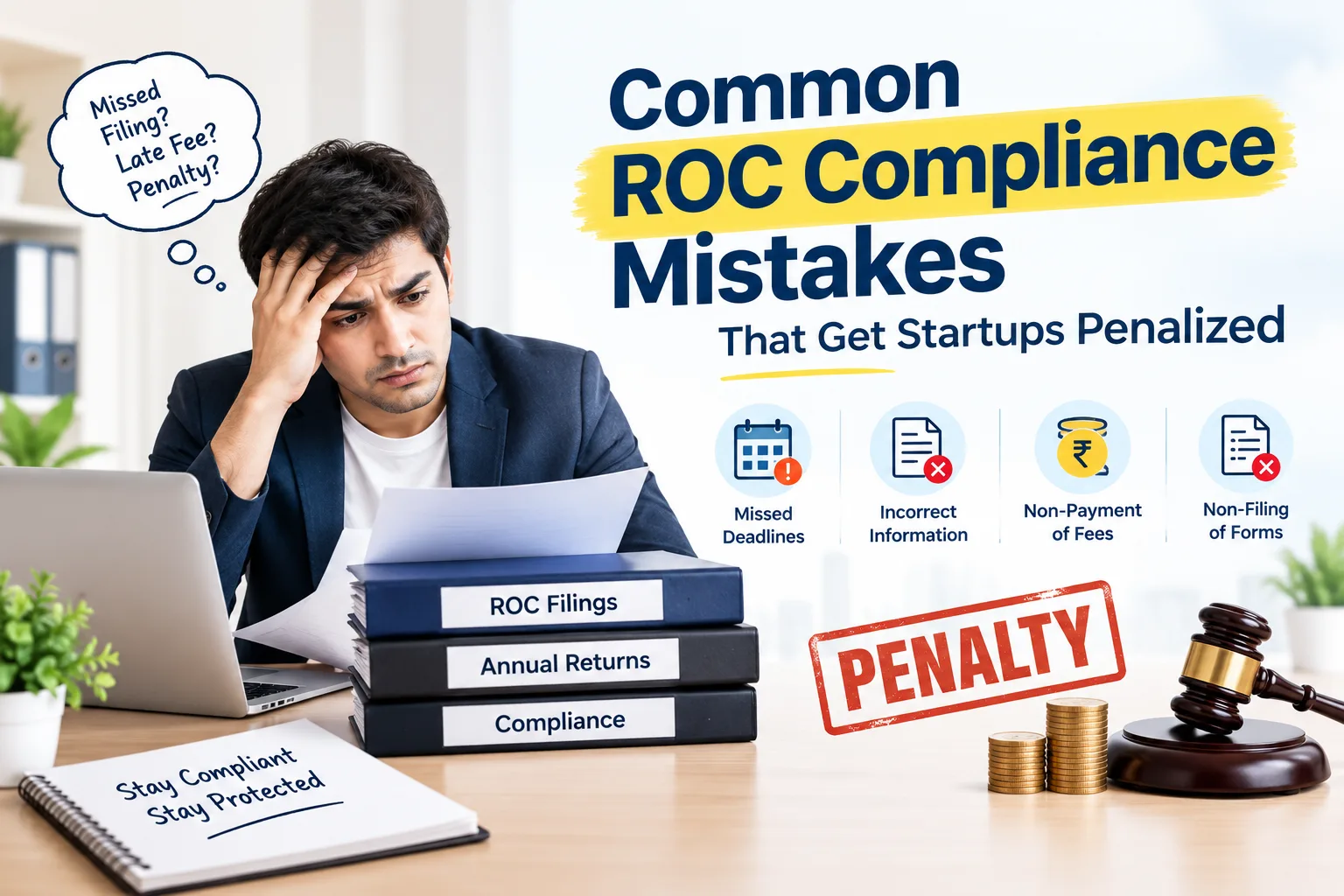
Most founders don’t think twice about ROC compliance — until a notice from the Registrar of Companies lands in their inbox. By then, what should’ve been a five-minute filing has quietly turned into a penalty running into lakhs, or worse, a director disqualification that follows them around for years. And here’s the frustrating bit: almost every one of these cases comes down to the same handful of mistakes, repeated company after company.
So if you’ve just incorporated, or you’ve been running your startup for a year or two with a nagging feeling that something’s fallen through the cracks, give this ten minutes. It’ll probably save you a lot more than that later.
Why ROC Compliance Gets Ignored (Until It Can’t Be)
When you’re building a product, chasing your first customers, and trying to make payroll every month, “file the annual return” just doesn’t feel urgent. Nothing bad happens the day you miss it — and that’s exactly the trap. ROC compliance under the Companies Act isn’t optional, and it isn’t something that quietly resolves itself either. The Ministry of Corporate Affairs has also gotten a lot sharper about tracking non-compliance now that everything runs through its online system — delays that used to slip under the radar get flagged almost automatically these days.
Here are the mistakes that show up again and again.
1. Missing the Annual Filing Deadlines (AOC-4 and MGT-7/MGT-7A)
Every private limited company, regardless of whether it did any business that year, must file:
- AOC-4 (financial statements) — within 30 days of the AGM
- MGT-7 / MGT-7A (annual return) — within 60 days of the AGM
A lot of startups assume that if there’s no revenue or activity, there’s nothing to report. That’s incorrect — a NIL business year still requires these filings. Miss them, and the penalty is ₹100 per day per form, per default, with no upper cap. That number grows every single day the delay continues, which is what turns a small oversight into a five-figure penalty within a few months.
2. Not Appointing a Statutory Auditor in Time (ADT-1)
Every company must appoint its first statutory auditor within 30 days of incorporation and file Form ADT-1 to notify the ROC. This is one of the most commonly skipped steps precisely because it happens so early — founders are focused on getting the business running, not on auditor paperwork in week one.
Skipping this doesn’t just risk a penalty; it can complicate your books later, since your financial statements technically need to be audited by a properly appointed auditor.
3. Ignoring DIR-3 KYC for Directors
Every individual holding a Director Identification Number (DIN) must complete DIR-3 KYC annually, even if they’re not actively running the company day-to-day. Miss this deadline, and the DIN gets deactivated — which then blocks that person from being appointed to other companies, signing certain filings, or in some cases continuing as a director on your own company’s records until it’s reactivated (with a late fee).
Founders with DINs often forget this applies to them personally, not just to “the company.”
4. Not Filing for Commencement of Business (INC-20A)
If your company was incorporated with share capital, you’re required to file INC-20A — a declaration confirming you’ve received subscription money and are ready to commence business — within 180 days of incorporation. Skip this, and you can’t legally start business operations, borrow money, or in worse cases, the company can be struck off the register entirely. This is one of the more serious mistakes on this list because the consequence isn’t just a fine — it’s an operational block.
5. Delayed or Missing PAS-3 for Share Allotments
Whenever a company allots new shares — to founders, early investors, or during a funding round — it must file Form PAS-3 within 30 days of the allotment. Startups raising quick bridge rounds or adding co-founders after incorporation often let this slip, especially when the round closes informally before the paperwork catches up. Delayed filing attracts penalties and can create complications later when investors or acquirers do due diligence and find share allotments that were never properly registered with the ROC.
6. Treating the Registered Office Casually
Many early-stage startups register their office at a co-working space, a founder’s home, or a temporary address — and then move without updating the ROC via Form INC-22. Any change in the registered office must be notified within 15 days. Companies that move offices (which happens often in the early years) and forget this step end up with official correspondence, notices, and even legal documents going to an address they no longer occupy — which can mean missing a compliance notice entirely until it’s too late.
7. Not Maintaining Statutory Registers and Minutes
This one doesn’t usually trigger an immediate monetary penalty, but it’s a mistake that compounds. The Companies Act requires maintaining registers of members, directors, charges, and proper minutes of board meetings and AGMs. Startups that skip this — often because there’s no “paperwork culture” in a two-person founding team — find themselves scrambling during due diligence for funding rounds or an acquisition, when investors’ lawyers ask for records that simply don’t exist.
8. Missing DPT-3 (Return of Deposits)
Many founders don’t realize that loans from directors, inter-company borrowings, and certain other receipts need to be reported annually via DPT-3, even when the company hasn’t taken what it would consider a formal “deposit.” This filing is often missed simply because founders don’t know it applies to informal arrangements, like a director personally funding the company in its early months.
What These Mistakes Actually Cost
Individually, each missed filing might look like a manageable late fee. But penalties compound daily in several of these cases, and more importantly, repeated non-compliance puts your directors personally at risk of disqualification — which follows them across every company they’re associated with, not just yours. It can also derail funding rounds, since investors routinely run ROC compliance checks as part of due diligence, and a messy compliance history raises red flags before a single term sheet is signed.
How to Stay Ahead of This
Notice the pattern across almost every mistake on this list — none of them are complicated. They’re just about timing. Each one is a predictable, recurring deadline tied to a fixed event: incorporation, your AGM, a share allotment, an office move. None of it should come as a surprise, and a simple compliance calendar built around your company’s actual incorporation date and AGM schedule would prevent most of these headaches before they start.
Easier said than done, though, when you’re also trying to run the actual business. Between product, hiring, and fundraising, tracking eight different ROC forms with eight different deadlines is the kind of thing that quietly slips — which is exactly why most growing startups eventually hand this over to someone who tracks it full-time, so a missed form never turns into a director disqualification or a stalled funding round.
Need Professional Tax & Compliance Support?
From Income Tax and GST to business registration, ROC compliance, accounting, TDS, FSSAI, trademark and other business services, JSR Taxes Mentor helps businesses and professionals stay compliant and manage their financial and regulatory requirements with confidence.
Need assistance with your tax or business compliance?
Contact JSR Taxes Mentor for professional guidance and reliable support.
🌐 Website: jstax.in
📞 Call/WhatsApp: 98187 55563 | 93506 63558