When the Goods and Services Tax (GST) was introduced in India in July 2017, it replaced many indirect taxes that businesses had been dealing with for years. Earlier, companies had to manage taxes like VAT, service tax, excise duty, and several state-level taxes. Each state had different rules, which often created confusion and extra work for businesses operating in multiple locations.
GST was introduced to make this system simpler. Instead of many different taxes, the government created a unified tax structure that applies to goods and services across the country. For businesses, this meant a more organized system, although it also required learning new compliance rules.
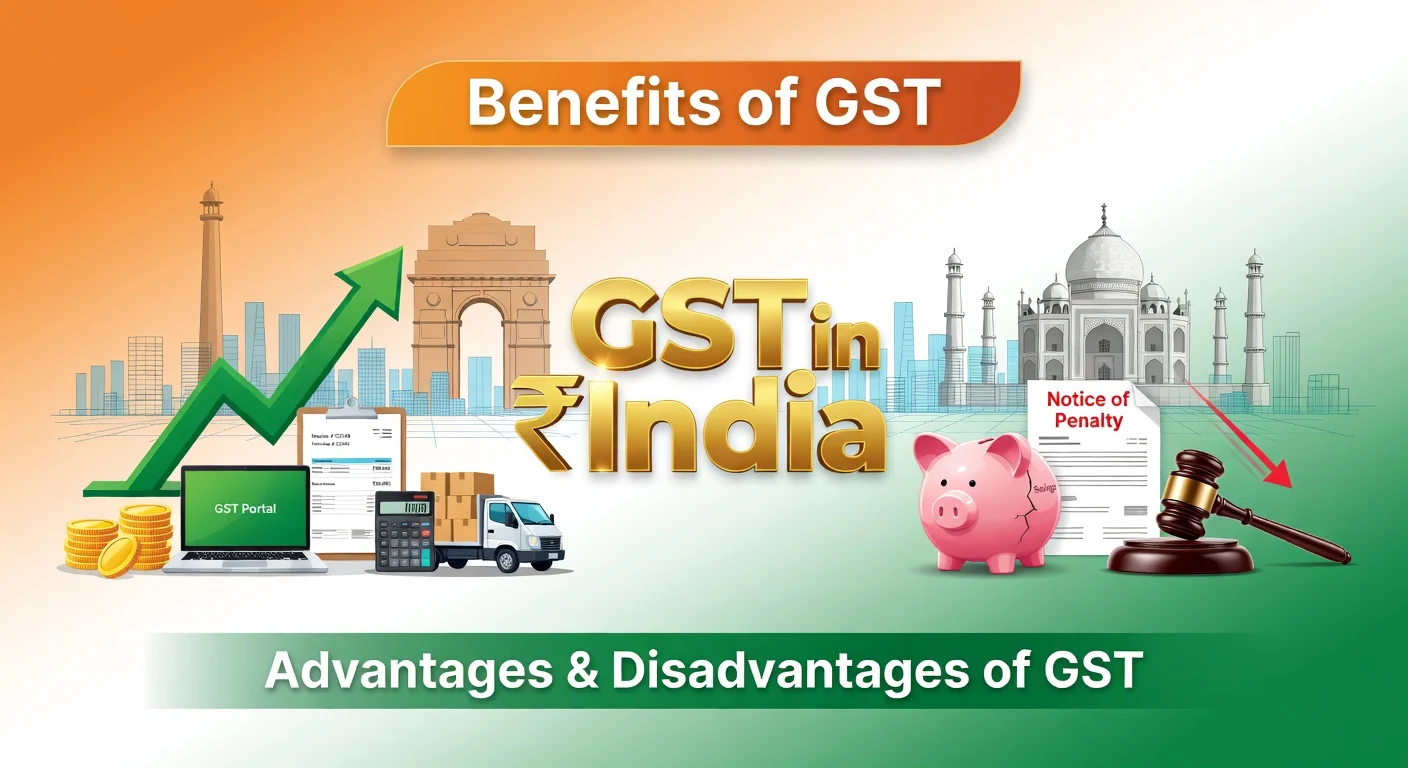
In this article, we’ll look at the benefits of GST in India, along with some of the advantages and disadvantages of GST that businesses should understand.
What GST Means for Businesses
GST is an indirect tax that applies to the supply of goods and services. The tax is collected at different stages of production or sale, but the final cost is usually paid by the consumer.
The system is designed so that businesses can claim credit for the tax they pay on purchases used for their business activities. This feature helps prevent the problem of paying tax multiple times on the same product.
Major Benefits of GST in India
1. A More Consistent Tax System
One of the biggest changes GST brought was uniformity. Before GST, businesses had to deal with different tax structures in different states. For example, a company selling products in Delhi, Maharashtra, and Karnataka might have had to follow three different sets of tax rules.
With GST, the tax structure became more consistent across the country. This has made it easier for businesses to expand and operate in multiple states.
2. Reduction of Multiple Taxes
Earlier, businesses were required to pay and manage several indirect taxes. These included VAT, service tax, excise duty, entry tax, and others. Handling so many taxes often created confusion and increased compliance work.
GST simplified this system by bringing most of these taxes under a single framework. As a result, businesses now deal with a more streamlined taxation process.
3. Input Tax Credit Helps Businesses Save Money
One of the most important advantages of GST is the Input Tax Credit (ITC) system.
Under this system, businesses can claim credit for the tax paid on goods or services purchased for business use. For example, if a company buys raw materials and pays GST on them, that amount can be adjusted against the GST collected when the final product is sold.
This reduces the chances of tax being charged multiple times and helps lower the overall tax burden.
4. Easier Movement of Goods Across States
Before GST, transporting goods between states often involved extra paperwork and additional taxes. These procedures sometimes caused delays in supply chains.
GST simplified interstate trade through the Integrated GST (IGST) mechanism. Because of this, goods can now move more smoothly between states, which benefits manufacturers, traders, and logistics companies.
5. Greater Transparency in Tax Compliance
Another positive impact of GST is the shift toward a more digital tax system. Businesses can now complete many processes online, including:
- Applying for GST registration
- Filing GST returns
- Making tax payments
This digital approach has made tax records easier to track and has improved transparency in the system.
6. Composition Scheme for Small Businesses
GST also introduced the composition scheme, which helps small businesses with lower turnover. Under this scheme, eligible businesses can pay tax at a fixed rate and follow simpler compliance procedures.
For many small traders and service providers, this option reduces the complexity of regular GST filings.
Disadvantages of GST in India
Even though GST has many advantages, businesses also face some practical challenges.
1. Regular Return Filing Requirements
GST requires businesses to file returns periodically and maintain proper records of invoices and transactions. For businesses that were previously outside the tax system, this has increased compliance responsibilities.
Many companies now rely on accountants or tax professionals to handle these filings.
2. Dependence on Online Systems
Because most GST processes are handled through the online portal, businesses must rely on internet-based systems. Companies that are not familiar with digital platforms may initially find this challenging.
However, as businesses become more comfortable with the system, this difficulty usually reduces.
3. Penalties for Non-Compliance
GST includes penalties for late return filing or incorrect reporting. Businesses must ensure that they follow deadlines and maintain accurate records to avoid additional costs.
Proper accounting practices and professional guidance can help manage these risks.
Overall Impact of GST in India
Over the years, GST has played a significant role in making India’s indirect tax system more organized. The introduction of a unified tax structure has helped simplify interstate trade and encouraged better tax compliance.
At the same time, businesses must stay aware of their responsibilities under GST to ensure smooth operations.
Conclusion
The benefits of GST in India are clear in terms of simplifying the tax structure, reducing the number of indirect taxes, and improving transparency. At the same time, businesses must manage compliance requirements and ensure timely return filing.
Understanding the advantages and disadvantages of GST helps entrepreneurs and companies operate more efficiently while staying compliant with tax regulations.