
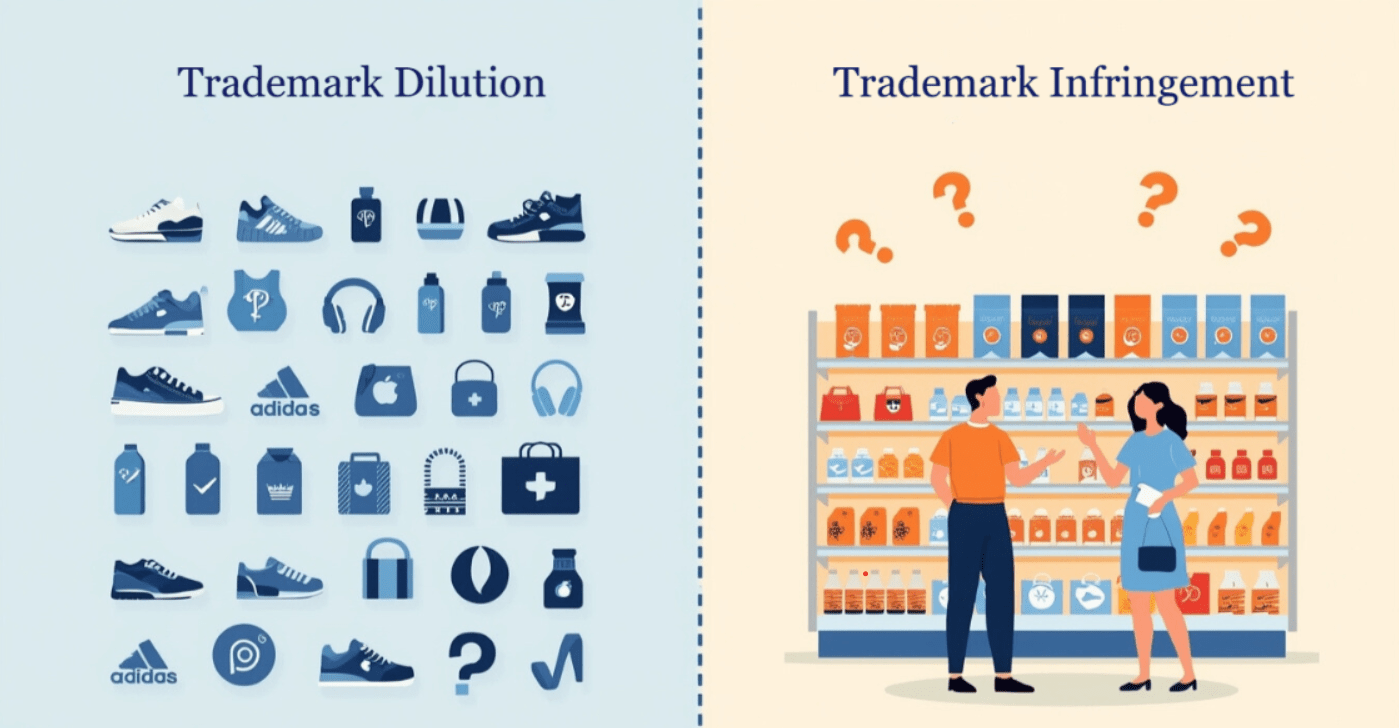
In real client conversations, trademark problems rarely come neatly labelled as “infringement” or “dilution”. Most business owners simply say, “Someone is using a similar name. What should I do?”
That’s where the confusion starts.
While trademark infringement and trademark dilution sound similar, the law treats them very differently. Understanding this difference matters because the wrong legal approach can weaken your case, even if your brand is genuinely being misused.
Let’s Start With Trademark Infringement (The More Common Issue)
Trademark infringement is what most startups and small businesses face.
It usually happens when another business uses a name, logo, or brand identity that is close enough to yours to confuse customers. The key word here is confusion. If customers might assume that two businesses are connected, infringement comes into play.
For example, if you have a registered trademark and someone launches a similar brand in the same or related business category, customers may start calling the wrong number, visiting the wrong website, or assuming both brands are the same. That commercial confusion is exactly what trademark law tries to prevent.
Indian courts focus heavily on how an average customer would perceive the two brands. If confusion is likely, infringement is usually established under Section 29 of the Trade Marks Act, 1999.
Trademark Dilution Works on a Different Logic
Trademark dilution in India is not about confused customers.
It is about protecting the strength and reputation of a brand, especially when that brand has become widely known.
Dilution applies mainly to well-known trademarks. These are brands that people recognize even outside their actual product category. When such a brand name is used casually or commercially by others, it slowly loses its exclusivity.
Imagine a famous brand name being used for unrelated, ordinary products. Customers may not think both businesses are linked, but the brand’s uniqueness starts fading. Over time, that brand stops feeling “special”. That silent damage is what trademark dilution law addresses.
Indian law recognizes this under Section 29(4) of the Trade Marks Act, even when goods or services are completely unrelated.
How Dilution Actually Happens in Practice
From experience, dilution usually shows up in two ways.
Sometimes, a famous trademark starts appearing everywhere — different businesses, different products, different industries. This weakens the identity of the original brand. That’s dilution by blurring.
In more serious cases, a reputed trademark is associated with poor quality, unethical, or questionable products. This damages the brand’s reputation directly. Courts tend to be strict in such tarnishment cases.
The Practical Difference Most People Miss
Here’s the simplest way to understand it:
- Infringement protects customers
- Dilution protects brands
Infringement law asks: Will customers get confused?
Dilution law asks: Is the brand losing its distinctiveness or reputation?
Another important difference is eligibility. Any trademark registration can claim infringement. Dilution protection, however, is usually available only to trademarks that have built significant recognition and goodwill.
Which One Applies to Your Business?
If you’re a startup or a growing business, infringement is more likely to affect you first. It directly impacts sales, trust, and customer perception.
Dilution becomes relevant once a brand has reached a level where its name itself carries value beyond products or services. At that stage, even unrelated misuse can cause long-term harm.
Legal Remedies in India
Indian trademark law provides strong remedies in both cases. Courts can stop unauthorized use, award damages, and pass strict injunctions. However, timing matters. Delays often weaken even strong trademark claims.
That’s why early legal assessment is crucial before sending notices or filing cases.
Closing Thoughts
Trademark infringement and trademark dilution are not interchangeable terms, even though they are often used that way.
One deals with market confusion. The other deals with brand erosion.
Knowing the difference helps business owners take the right legal route, avoid unnecessary disputes, and protect the brand they’ve worked hard to build.
If a trademark issue is ignored or handled incorrectly, the damage is usually far more expensive than the solution.